

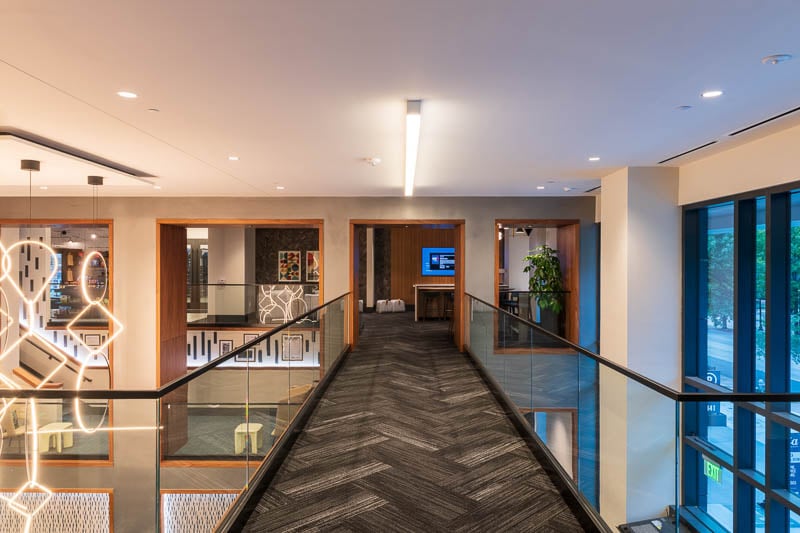
Commercial interior paint systems are layered coatings – primer, optional intermediate, and topcoat – specified together so each layer does work the next cannot. In high-traffic commercial interiors, the system, sheen, and chemistry are matched to the zone (lobby, corridor, restroom, back-of-house) and to the sector (healthcare, education, office, retail), not chosen from a single can across the building.
A scuff line shows up at eye level in a Class A lobby six months after the GC handed it over. A school corridor chalks and burnishes inside two years. A hospital wall fails its scrub cycle and the maintenance team starts touching up monthly. From the outside these look like paint problems. They are almost always specification problems – and specifically, they are decisions made about a single can of paint when the right answer was a layered, zone-matched system. For property teams running commercial interior coatings programs across mixed-use portfolios, the difference between a five-year repaint cycle and a two-year repaint cycle is rarely the brand on the bucket. It is the system architecture, the sheen logic, and the chemistry behind it.
What Commercial Interior Paint Systems Actually Are
In residential work, “paint” usually means a topcoat. In commercial interiors built to spec, a paint system is a stack: a primer, sometimes an intermediate coat, and a topcoat – each chosen to do work the next layer cannot. Architects and spec writers treat it that way for a reason. Commercial walls take damage from rolling carts, backpacks, gurneys, cleaning chemicals, and disinfectant cycles that residential interiors never see. The film has to be designed as a system, not borrowed from a residential aisle.
Primer: the layer that decides how long the system lasts
Primer is the unglamorous layer that determines whether a topcoat performs to its rated life. Its job is adhesion to the substrate, stain blocking, and stabilizing whatever is underneath – drywall, prior coatings, or a repaint substrate carrying decades of patches and skim coats. On new gypsum, a high-build acrylic primer levels surface defects that would otherwise telegraph through any topcoat. On repaints, a bonding primer locks down chalking or glossy legacy coatings that would cause peeling later. Skipping or under-speccing the primer is the most common reason a “premium” topcoat fails inside two years.
Intermediate and topcoat: where durability is built and shown
A two-coat finish – primer plus two coats of a high-performance topcoat – works for moderate-traffic interiors with light to mid-tone colors. A three-coat system becomes non-negotiable in true high-traffic zones, in repaints over dark or uneven colors, and anywhere the wall film has to survive frequent cleaning. The third coat is not a safety margin. It is the coat that builds film thickness – and film thickness is what turns scuffs and scrubs into something the paint shrugs off rather than telegraphs.
Choosing by Zone and Traffic Level
The most expensive mistake in a commercial interior spec is using one product across the entire building. A 200,000-square-foot office tower has at least four traffic profiles, and the right system maps each one. Walk the building first, then write the spec.
Lobbies, vestibules, and main corridors
These zones see the highest impact at the lowest tolerance for visible wear. Scuffs, fingerprints, and burnish marks (the shiny patches that appear when a soft film is rubbed) all show in raking light from glass facades. The chemistry to solve this is a urethane-modified acrylic or a purpose-built scuff-resistant topcoat. Categories worth specifying include:
- Sherwin-Williams ProMar 200 HP – urethane-fortified interior acrylic
- Benjamin Moore Ultra Spec SCUFF-X – engineered for scuff and burnish resistance
- PPG Pittsburgh Paints Anti-Scuff Interior – high-performance acrylic for high-traffic walls
All three are examples of the urethane-fortified acrylic class engineered for this exact failure mode. [Verify with Socium SME: confirm preferred lobby spec across recent Atlanta Class A jobs.]
Restrooms, breakrooms, and wet zones
The dominant stress is moisture combined with a cleaning regimen heavier than the rest of the building. Standard latex breaks down. The right system pairs a mildew-resistant primer with a satin or semi-gloss acrylic carrying a mildewcide, or – on chronically wet substrates and around fixtures – a two-part epoxy. Sheen matters here for two reasons: it sheds moisture, and it survives daily wipe-downs without burnishing.
Back-of-house, mechanical rooms, and service corridors
These zones are not customer-facing, but they take the worst impact and chemical exposure in the building. The spec stops being decorative and starts being protective. Direct-to-metal (DTM) acrylics replace standard latex on exposed steel. Epoxy systems get specified on concrete block walls in mechanical rooms. The trade-off is recoatability – these films are harder to refresh later – and the spec should account for it in the maintenance plan from day one.
Sheen, Chemistry, and the Trade-Offs That Actually Matter
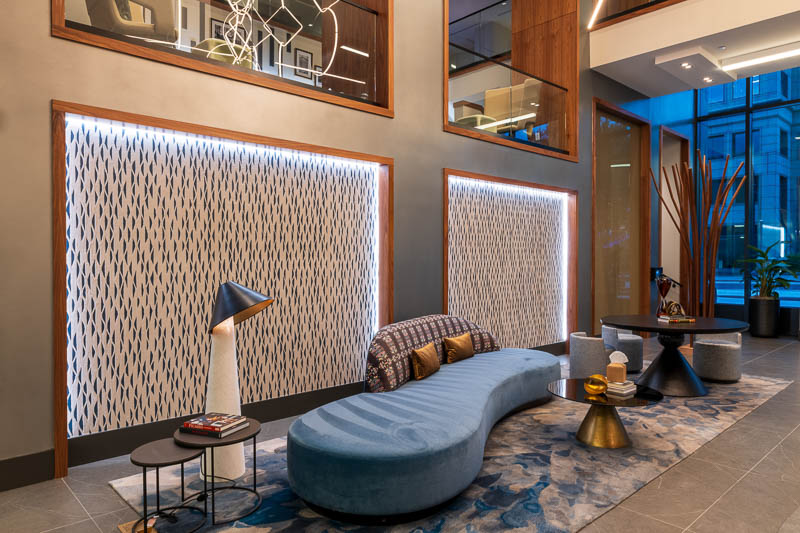
Most generic guides reduce sheen to a chart. That chart is incomplete because it ignores how sheen interacts with chemistry, with lighting, and with how forgiving the wall is of repairs.
Sheen tied to washability – and to wall-repair telegraphing
Higher sheen scrubs better and shows every drywall defect. Lower sheen hides defects and stains more easily. The practical compromise in most commercial lobbies and corridors is an eggshell or low-sheen finish in a high-performance line – enough cleanability for a maintenance team, low enough sheen to forgive the patch the GC made over a punch-list nail pop. Reserve true semi-gloss for trim, doors, and door frames where chemical disinfection happens, and keep gloss for areas that need to be wiped down constantly.
Acrylic, urethane-modified, and waterborne alkyd – what each actually does
Three failure modes look similar to a tenant and very different to a coatings spec writer: scrubbing (cleaning damage), scuffing (impact damage from a shoe or cart), and burnishing (sheen change from repeated rubbing). A standard 100% acrylic eggshell can score well on scrubbing and poorly on scuffing. A urethane-modified acrylic addresses all three, which is why it dominates current high-traffic commercial specifications. On doors, trim, and frames, waterborne alkyd-urethane enamels – the Sherwin-Williams Emerald Urethane Trim Enamel category is one example – give the hand-feel and block resistance of an oil-based enamel without the VOC penalty.
Low-VOC and IAQ for occupied buildings
Most commercial repaints happen in occupied buildings. That makes VOC content an operational variable, not a sustainability checkbox. A low- or zero-VOC system determines whether a corridor can be re-occupied that same evening or whether a floor has to stay closed overnight. For LEED, WELL, and most healthcare facilities, the spec also has to document compliance – Master Painters Institute (MPI) Green Performance, SCAQMD Rule 1113, or CDPH 01350 references all show up routinely in real specifications.
Sector Recommendations: Where the Spec Has to Bend
Generic high-traffic guidance breaks down at the sector level. The same lobby paint that works in a Class A office is wrong in a hospital corridor and wrong again in a middle school. The system has to bend to the operational reality of the sector.
Healthcare – washability, antimicrobial, infection control
Hospitals and outpatient facilities run cleaning regimens no other commercial sector matches. The spec needs paints rated for repeated disinfection without sheen change, often with antimicrobial additives that suppress microbial growth on the film surface. Door frames and high-touch trim move to semi-gloss or gloss because they get wiped daily. For Socium’s healthcare facility coatings work, system architecture extends past the wall – corner guards, FRP panels, and seamless flooring all have to integrate with the wall coating in a way that holds up to OSHA, HIPAA, and ADA expectations.
Education – abuse from backpacks, lockers, and cleaning chemicals
K-12 corridors and university higher-education facility coatings take impact damage no other building type sees. Scuff-resistant eggshell handles most classroom walls; semi-gloss or block-filled epoxy belongs in cafeterias, locker rooms, and gymnasiums. Color strategy matters here too – mid-tone wall colors hide scuffs that show on white drywall by Halloween of any school year.
Office and Class A interiors – appearance retention under low light
In a Class A office, burnish resistance often matters more than scrub rating because the cleaning regimen is light but the lighting is unforgiving. Matte and eggshell scuff-resistant lines are usually the right call. Touch-up consistency is also a procurement variable – single-batch paint storage, consistent application by a trained crew, and documented sheen tracking matter as much as the chemistry. For property managers running office building painting scopes across multiple tenants, a standardized system across the portfolio simplifies repaint cycles and tenant turnover.
Retail and hospitality – turnover speed and brand consistency
Retail repaints happen overnight or between shifts, hospitality between bookings. Fast re-occupancy means low-VOC and fast-recoat formulations are mandatory, not optional. Color match across seasons matters because brand standards do not tolerate the slight tonal drift that happens between paint batches. Dark accent walls are common in this sector and need extra coats and, often, a tinted primer to avoid flashing.
Why Atlanta Property Teams Trust Socium Coatings
A commercial interior paint system is a procurement decision dressed up as a product choice. Specced correctly, it stretches a repaint cycle from three years to five or seven, cuts maintenance touch-up labor, and protects tenant experience in the spaces where impressions are formed. Specced poorly, no premium topcoat saves it. Socium specs commercial interiors the same way it specs aviation and federal coatings – primer-led, sector-matched, sheen-aware, and built around how the building actually operates. The same discipline general contractors look for in a certified commercial painting subcontractor in Atlanta carries through to interior work. To scope a paint system for a lobby refresh, a corridor repaint, or a multi-floor tenant build-out, request a quote for your commercial interior scope and our team will walk the building before recommending a single product.




Leave A Comment